

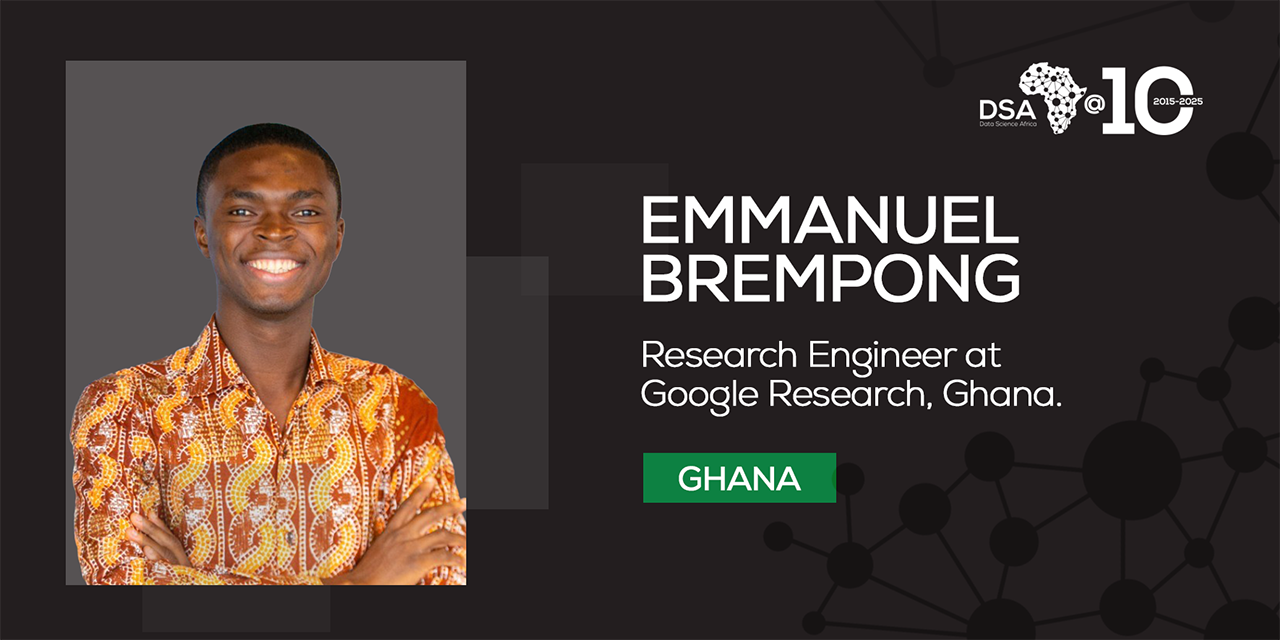
In 2019, when I finished university, I wasn’t sure how to turn my passion for artificial intelligence (AI) into a career. In Ghana, people told me, “You can’t really do AI here, you have to go abroad.” I believed that, until I attended Data Science Africa (DSA) in Accra that same year.
I studied computer science at the University of Mines and Technology (UMaT), Tarkwa, and at the time, AI felt distant. It’s like something happening only in Silicon Valley or London. The DSA conference was the first real research platform I ever got to present on. My project was about detecting cocoa diseases using computer vision. The project wasn’t fancy, just something I worked on with friends after school. And I was terrified of presenting it at the conference, surrounded by researchers. But it was also the first time someone treated my small project as real research. I got questions, feedback, encouragement and most importantly, a network.
That network shaped the direction of my career. I met people like John Quinn and Ernest Mwebaze, who were then with Google Research. They invited me to present my project at their office in Accra. I remember walking into that space filled with people who looked like me, but were building world-class AI systems, and realizing that this was possible here in Africa.
A year later, I applied for Google’s AI Residency program. The first time, I didn’t get in. The second time, I did. That program was my real introduction to structured research. For 18 months, I learned to think like a scientist, work in teams, and solve tough problems in computer vision and machine learning. After that, I joined Google Research full time in Accra.
Today, I lead projects on weather forecasting, building AI models that can predict rainfall in parts of Africa where we don’t have radar data. Our models are now used across Africa, India, Brazil, and Australia.
Before DSA, my research was just me and a few friends experimenting. After DSA, I had mentors, collaborators, and a sense of belonging in a community. I met people I still work with today at DSA. It’s where I learned that you don’t have to leave Africa to build world-class AI – you can do it right here.
DSA gave me a stage, and that stage led to every opportunity since, changing my perception of what’s possible. Now, when I think about the next generation of African AI researchers, I see DSA as the driving force. It’s where the continent’s data scientists learn not just how to build technology, but why it matters and how far it can take us when we build for ourselves.